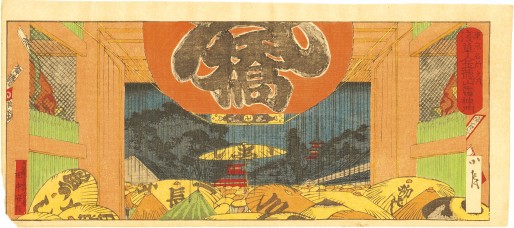
Sadanobu II was an artist who carried the spirit of traditional Kamigata-e (Osaka) into the modern era without letting it fade, during the turbulent transition of Osaka from the Edo period to the Meiji era. The true essence of his artistic achievement lies in two areas: his landscape prints, which vividly captured the rapidly transforming cityscape of Osaka against the backdrop of the famous-place tradition inherited from his teacher and father, the first-generation Sadanobu; and his continuation of actor prints, a source of pride in the Kamigata tradition.
In a manner that resonated with how Hiroshige III brilliantly depicted the civilization and enlightenment of “Tokyo,” Sadanobu II recorded in nishiki-e the vitality of Osaka as a “city of water,” where steamships came and went, gas lamps were lit, and Western-style buildings rose in succession. While grounded in the refined perspective techniques passed down from the first generation, his brushwork boldly incorporated the vivid colors characteristic of the Meiji period, superbly expressing the sense of excitement surrounding a new age.
Furthermore, in the realistic actor prints that form a core tradition of Kamigata-e—known for sharply capturing the individuality of performers—he went beyond mere stylistic imitation. By reflecting stage lighting effects and subtle, modern nuances of expression, he achieved a level of realism approaching that of modern portraiture, all while remaining firmly within the framework of ukiyo-e.
In a manner that resonated with how Hiroshige III brilliantly depicted the civilization and enlightenment of “Tokyo,” Sadanobu II recorded in nishiki-e the vitality of Osaka as a “city of water,” where steamships came and went, gas lamps were lit, and Western-style buildings rose in succession. While grounded in the refined perspective techniques passed down from the first generation, his brushwork boldly incorporated the vivid colors characteristic of the Meiji period, superbly expressing the sense of excitement surrounding a new age.
Furthermore, in the realistic actor prints that form a core tradition of Kamigata-e—known for sharply capturing the individuality of performers—he went beyond mere stylistic imitation. By reflecting stage lighting effects and subtle, modern nuances of expression, he achieved a level of realism approaching that of modern portraiture, all while remaining firmly within the framework of ukiyo-e.