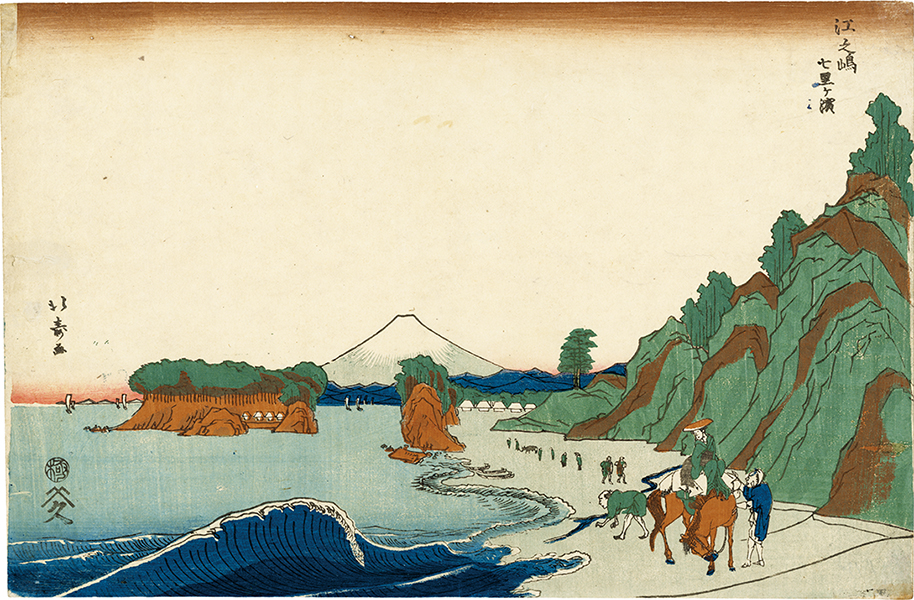
Hokuju was an ukiyo-e artist active in the late Edo period, roughly from the early 19th century. A pupil of Hokusai, he pushed his master’s teachings in an exceptionally original—and at times extreme—direction. At the core of his artistic practice was the completion of uki-e (perspective pictures) that rigorously incorporated Western-style linear perspective, a technique still rare in Japan at the time.
Hokuju’s landscapes stand apart from the lyrical, atmospheric scenery favored by many other ukiyo-e artists. Mountains and rocks are rendered with a distinctive sense of form, often appearing geometric or almost crystalline. His depictions of sheer cliffs and billowing clouds, in particular, possess a forceful clarity and cool intellectual rigor, as if nature itself had been structurally dismantled and reconstructed. Even to modern viewers, the sculptural quality of these forms appears strikingly modern and highly compositional. Roads and rivers that converge sharply into depth compel the viewer’s gaze irresistibly into the far reaches of space, transforming Edo cityscapes and famous Japanese sites into panoramas with an uncanny, otherworldly sense of presence.
In his use of color as well, Hokuju employed clear contrasts—most notably between deep blues of the sky and earthy tones of the land—while emphasizing volume through shading that heightens the three-dimensionality of buildings and terrain. While Hokusai sought to capture the “essence of things,” Hokuju inherited this ideal in the form of a desire to command the very structure of space itself. Within the framework of ukiyo-e, he pursued an intensely experimental mode of landscape expression. By remaining faithful to this singular style throughout his life, Hokuju left a rare and important legacy: at a time when landscape prints were gaining prominence toward the end of the Edo period, he elevated linear perspective from a mere technique into a central expressive force of art itself.
Hokuju’s landscapes stand apart from the lyrical, atmospheric scenery favored by many other ukiyo-e artists. Mountains and rocks are rendered with a distinctive sense of form, often appearing geometric or almost crystalline. His depictions of sheer cliffs and billowing clouds, in particular, possess a forceful clarity and cool intellectual rigor, as if nature itself had been structurally dismantled and reconstructed. Even to modern viewers, the sculptural quality of these forms appears strikingly modern and highly compositional. Roads and rivers that converge sharply into depth compel the viewer’s gaze irresistibly into the far reaches of space, transforming Edo cityscapes and famous Japanese sites into panoramas with an uncanny, otherworldly sense of presence.
In his use of color as well, Hokuju employed clear contrasts—most notably between deep blues of the sky and earthy tones of the land—while emphasizing volume through shading that heightens the three-dimensionality of buildings and terrain. While Hokusai sought to capture the “essence of things,” Hokuju inherited this ideal in the form of a desire to command the very structure of space itself. Within the framework of ukiyo-e, he pursued an intensely experimental mode of landscape expression. By remaining faithful to this singular style throughout his life, Hokuju left a rare and important legacy: at a time when landscape prints were gaining prominence toward the end of the Edo period, he elevated linear perspective from a mere technique into a central expressive force of art itself.