


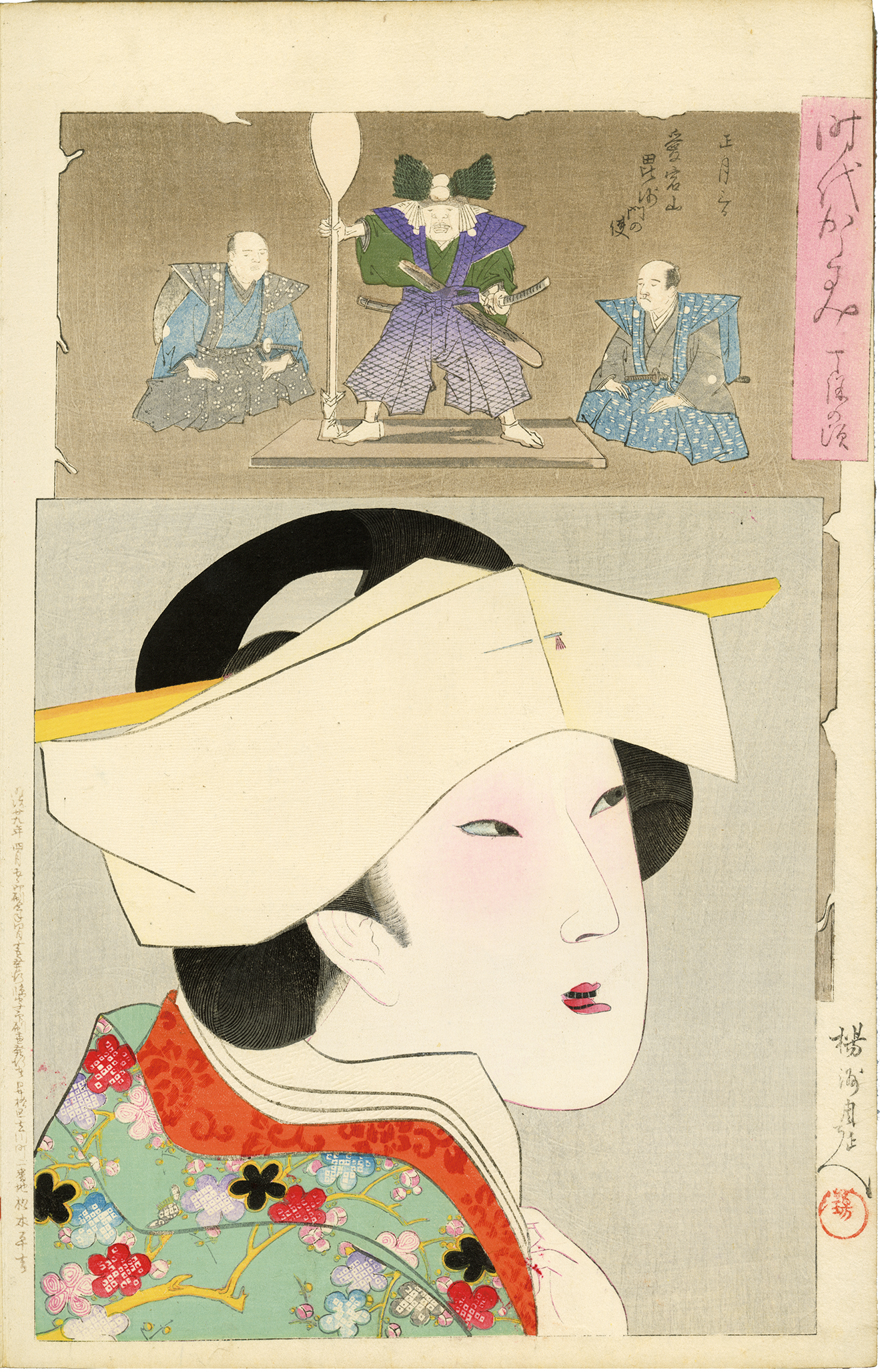

周延 / 時代かがみ 天保の頃 正月三日 愛宕山毘沙門の使
SKU: C23140
スマートフォンのお客様は画像上でダブルタップすると拡大画像をご覧いただけます。
Please double-tap on the image to zoom up images.
作品
年代 : 明治29年
サイズ : 大判
刷 : 良
保存 : 良
詳細 : 裏打 / 少汚れ
ディレクターコメント
上図に描かれているのは、愛宕山権現の別当寺・円福寺の「強飯式(ごうはんしき)」に登場する毘沙門天の使いである。強飯式とは大盛りの飯を修行僧などに残さず食べるよう強要する奇祭で、供物を大切にする教えを伝えるという意味合いがあったという。使いは手にした大きなしゃもじを杖にしながら目もくらむ急な男坂を登り、境内で儀式を行った。この様子は名所江戸百景など他の作品にも多く登場し、当時よく知られていた事が窺える。
円福寺は明治の廃仏毀釈によって廃寺となり、この儀式もなくなってしまった。
時代かがみは、建武時代から明治における美人を当時の髪型とファッションで描いており、約500年にも及ぶ美人の遍歴を辿ることができる。画面上段には、当時流行していた文化・芸能・行事・職業等が描かれており、歴史の移り変わりも楽しめる。
周延は国芳に絵を学んで芳鶴二代を名乗るが、国芳の死後は豊国三代につき、さらに豊国三代が亡くなると国周に転じて周延と号した。
明治に入ると当初は武者絵や西南戦争の絵を描いて評判を取る。その後は江戸っ子が知らない、江戸城大奥の風俗画や明治開化期の婦人風俗画などを描き、江戸浮世絵の再来と大変な人気を博した。これにより、周延は明治期で一番人気の美人画絵師となっている。
作品ページの見方とご購入ガイド
Information
Date : 1896
Size : O-ban
Impression : Good
Condition : Good
Detail : Backed / Slight browning
The man depicted above is a messenger of Bishamonten, who appears in the "Gohan-Shiki" ceremony at Enpuku-Ji Temple, a Betto-Ji temple of Atagoyama Gongen. The Gohan-Shiki was a quirky festival that forced monks and others to eat a large bowl of rice without leaving any leftovers and was meant to teach them not to waste the offerings. The messenger climbed the steep Otoko-Zaka hill, using a large rice scoop as a walking stick, and performed the ceremony in the temple. This scene appears in many other Ukiyo-es, such as "One hundred Famous Views of Edo," suggesting that the ceremony was well known at that time.
Enpuku-Ji Temple was closed due to the"Haibutsu Kisyaku," the abolition of Buddhism, in the Meiji era (1868-1912), and this ceremony was no longer held there.
This is the series whose motifs are hairstyles and fashions of beauties from Kemmu-Era to Meiji-Era.
We can see the itinerant of the beauties which covers over 500 years.
On the upper side of the prints, there are depictions of culture, entertainment, events, and occupations, and these are also interesting.
Chikanobu used to use the name YoshitsuruⅡ, however, he became a pupil of ToyokuniⅡafter Kuniyoshi died, and after ToyokuniⅢ died, he became a pupil of Kunichika. Then, finally, his name became Chikanobu.
He was famous for the motif of beauties, however, one of the seeds that grow into a flowering of his art-life was the warrior prints and war prints of the Seinan War. After that, he started creating the artworks of Ooku, the shogun's harem, and the lady portrait in the civilization of the Meiji era. It raised his reputation. People had called his artworks "The second Edo Ukiyo-e", and he was one of the most popular artists whose motif is beauty.
Shopping Guide & Information of the Japanese Prints
Please double-tap on the image to zoom up images.
作品
年代 : 明治29年
サイズ : 大判
刷 : 良
保存 : 良
詳細 : 裏打 / 少汚れ
ディレクターコメント
上図に描かれているのは、愛宕山権現の別当寺・円福寺の「強飯式(ごうはんしき)」に登場する毘沙門天の使いである。強飯式とは大盛りの飯を修行僧などに残さず食べるよう強要する奇祭で、供物を大切にする教えを伝えるという意味合いがあったという。使いは手にした大きなしゃもじを杖にしながら目もくらむ急な男坂を登り、境内で儀式を行った。この様子は名所江戸百景など他の作品にも多く登場し、当時よく知られていた事が窺える。
円福寺は明治の廃仏毀釈によって廃寺となり、この儀式もなくなってしまった。
時代かがみは、建武時代から明治における美人を当時の髪型とファッションで描いており、約500年にも及ぶ美人の遍歴を辿ることができる。画面上段には、当時流行していた文化・芸能・行事・職業等が描かれており、歴史の移り変わりも楽しめる。
周延は国芳に絵を学んで芳鶴二代を名乗るが、国芳の死後は豊国三代につき、さらに豊国三代が亡くなると国周に転じて周延と号した。
明治に入ると当初は武者絵や西南戦争の絵を描いて評判を取る。その後は江戸っ子が知らない、江戸城大奥の風俗画や明治開化期の婦人風俗画などを描き、江戸浮世絵の再来と大変な人気を博した。これにより、周延は明治期で一番人気の美人画絵師となっている。
作品ページの見方とご購入ガイド
Information
Date : 1896
Size : O-ban
Impression : Good
Condition : Good
Detail : Backed / Slight browning
The man depicted above is a messenger of Bishamonten, who appears in the "Gohan-Shiki" ceremony at Enpuku-Ji Temple, a Betto-Ji temple of Atagoyama Gongen. The Gohan-Shiki was a quirky festival that forced monks and others to eat a large bowl of rice without leaving any leftovers and was meant to teach them not to waste the offerings. The messenger climbed the steep Otoko-Zaka hill, using a large rice scoop as a walking stick, and performed the ceremony in the temple. This scene appears in many other Ukiyo-es, such as "One hundred Famous Views of Edo," suggesting that the ceremony was well known at that time.
Enpuku-Ji Temple was closed due to the"Haibutsu Kisyaku," the abolition of Buddhism, in the Meiji era (1868-1912), and this ceremony was no longer held there.
This is the series whose motifs are hairstyles and fashions of beauties from Kemmu-Era to Meiji-Era.
We can see the itinerant of the beauties which covers over 500 years.
On the upper side of the prints, there are depictions of culture, entertainment, events, and occupations, and these are also interesting.
Chikanobu used to use the name YoshitsuruⅡ, however, he became a pupil of ToyokuniⅡafter Kuniyoshi died, and after ToyokuniⅢ died, he became a pupil of Kunichika. Then, finally, his name became Chikanobu.
He was famous for the motif of beauties, however, one of the seeds that grow into a flowering of his art-life was the warrior prints and war prints of the Seinan War. After that, he started creating the artworks of Ooku, the shogun's harem, and the lady portrait in the civilization of the Meiji era. It raised his reputation. People had called his artworks "The second Edo Ukiyo-e", and he was one of the most popular artists whose motif is beauty.
Shopping Guide & Information of the Japanese Prints

