


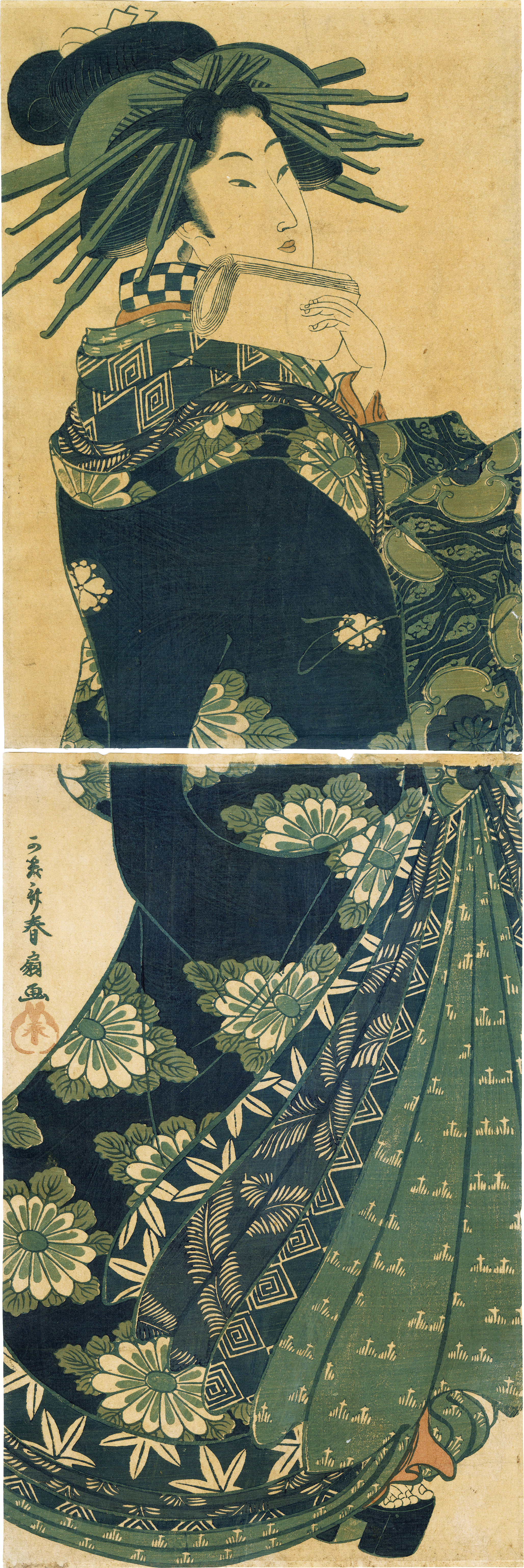

春扇 /(藍刷美人)
SKU: C25006
スマートフォンのお客様は画像上でダブルタップすると拡大画像をご覧いただけます。
Please double-tap on the image to zoom up images.
作品
年代 : -
サイズ : 大判2枚続
刷 : 良
保存 : 良
詳細 : ヤケ / 少汚れ / 小虫穴補修
ディレクターコメント
18世紀、ドイツのベルリンで発見された合成顔料の「プルシアン・ブルー」が日本に渡り、浮世絵にも盛んに用いられるようになった。ベルリンの名を取って「ベロ藍」と呼ばれたこの色は、それまで用いられてきた植物由来の「つゆ草」や「本藍」ともまた異なる、透明感のある青の表現を可能にした。
勝川春扇(しゅんせん)は春英の門人の絵師である。始めは秋琳と号し、春英の門人となった後は春扇、文政3年頃からは二代目春好と名乗った。
よって本作品は文政3年以前の作と考えられる。
作品ページの見方とご購入ガイド
Information
Date : -
Size : O-ban/ Vertical diptych
Impression : Good
Condition : Good
Detail : Soiled / Slight foxing / Restored small wormholes
In the 18th century, Prussian blue, a synthetic pigment discovered in Berlin, Germany, was imported to Japan and used in ukiyo-e prints. This color, called "Bero-ai" after the sound of Berlin, enabled the expression of a unique blue that was different from the plant-based color "Tsuyukusa" and "Hon-ai" that had been used until then and gave a sense of transparency to the color. *"Ai" means Indigo.
Katsukawa Shunsen was a painter who was a pupil of Shunei. His artist name was 秋琳 at first and shifted to 春扇 after becoming a student of Shunei, and 春好Ⅱ from 1820.
Therefore, this work is considered to have been produced before 1820.
Shopping Guide & Information of the Japanese Prints
Please double-tap on the image to zoom up images.
作品
年代 : -
サイズ : 大判2枚続
刷 : 良
保存 : 良
詳細 : ヤケ / 少汚れ / 小虫穴補修
ディレクターコメント
18世紀、ドイツのベルリンで発見された合成顔料の「プルシアン・ブルー」が日本に渡り、浮世絵にも盛んに用いられるようになった。ベルリンの名を取って「ベロ藍」と呼ばれたこの色は、それまで用いられてきた植物由来の「つゆ草」や「本藍」ともまた異なる、透明感のある青の表現を可能にした。
勝川春扇(しゅんせん)は春英の門人の絵師である。始めは秋琳と号し、春英の門人となった後は春扇、文政3年頃からは二代目春好と名乗った。
よって本作品は文政3年以前の作と考えられる。
作品ページの見方とご購入ガイド
Information
Date : -
Size : O-ban/ Vertical diptych
Impression : Good
Condition : Good
Detail : Soiled / Slight foxing / Restored small wormholes
In the 18th century, Prussian blue, a synthetic pigment discovered in Berlin, Germany, was imported to Japan and used in ukiyo-e prints. This color, called "Bero-ai" after the sound of Berlin, enabled the expression of a unique blue that was different from the plant-based color "Tsuyukusa" and "Hon-ai" that had been used until then and gave a sense of transparency to the color. *"Ai" means Indigo.
Katsukawa Shunsen was a painter who was a pupil of Shunei. His artist name was 秋琳 at first and shifted to 春扇 after becoming a student of Shunei, and 春好Ⅱ from 1820.
Therefore, this work is considered to have been produced before 1820.
Shopping Guide & Information of the Japanese Prints
最近見た作品
