


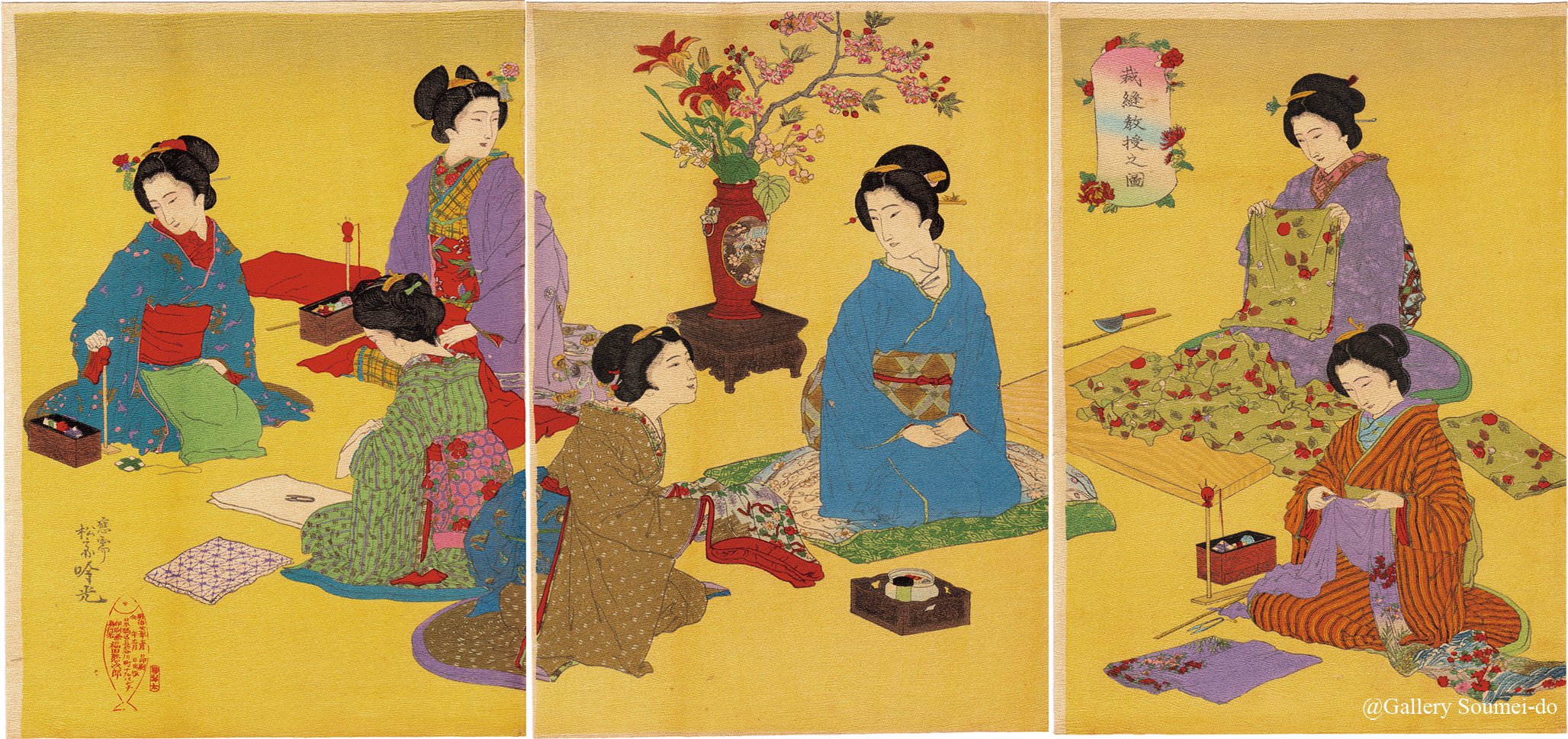
吟光 / 裁縫教授之図
SKU: C29107-3e-4
価格
¥51,000
スマートフォンのお客様は画像上でダブルタップすると拡大画像をご覧いただけます。
Please double-tap on the image to zoom up images.
作品
年代 : 明治21年
サイズ : 大判3枚続(チリメン、各26.3 × 18.8cm)
刷 : 良
保存 : 良
詳細 : 少汚れ
ディレクターコメント
家庭内でのたしなみとして行われた裁縫は、明治時代の教育制度の発展とともに職業訓練としての側面を強めていった。中心の青い着物の女性が先生であろうか。
また、こちらの作品はちりめんと呼ばれる、布地のちりめんによく似た細かい皴加工が施されている。
吟光(嘉永6年 - 明治35年)は明治に活動した浮世絵師である。初めは銀光の名で戊辰戦争の錦絵を描き、吟光に改名してからは役者絵や西南戦争、議会関係の報道画、美人画などモチーフは多岐にわたる。
作品ページの見方とご購入ガイド
Information
Date : 1888
Size : O-ban / Triptych(縮緬、各26.3 × 18.8cm)
Impression : Good
Condition : Good
Detail : Slight browning
Sewing, once practiced as a form of household accomplishment, gradually took on the character of vocational training with the development of the education system in the Meiji period. The woman in the blue kimono at the center is likely the teacher.
This work also features a fine crinkled texture known as chirimen, resembling the crepe fabric of the same name.
Ginko (1849 – 1902) was an ukiyo-e artist active during the Meiji period.
He first worked under the name Ginko (銀光), producing color prints depicting the Boshin War. After changing his name to Ginko (吟光), he created a wide range of works, including actor portraits, prints of the Satsuma Rebellion and parliamentary scenes, as well as bijinga (pictures of beautiful women).
Shopping Guide & Information
Please double-tap on the image to zoom up images.
作品
年代 : 明治21年
サイズ : 大判3枚続(チリメン、各26.3 × 18.8cm)
刷 : 良
保存 : 良
詳細 : 少汚れ
ディレクターコメント
家庭内でのたしなみとして行われた裁縫は、明治時代の教育制度の発展とともに職業訓練としての側面を強めていった。中心の青い着物の女性が先生であろうか。
また、こちらの作品はちりめんと呼ばれる、布地のちりめんによく似た細かい皴加工が施されている。
吟光(嘉永6年 - 明治35年)は明治に活動した浮世絵師である。初めは銀光の名で戊辰戦争の錦絵を描き、吟光に改名してからは役者絵や西南戦争、議会関係の報道画、美人画などモチーフは多岐にわたる。
作品ページの見方とご購入ガイド
Information
Date : 1888
Size : O-ban / Triptych(縮緬、各26.3 × 18.8cm)
Impression : Good
Condition : Good
Detail : Slight browning
Sewing, once practiced as a form of household accomplishment, gradually took on the character of vocational training with the development of the education system in the Meiji period. The woman in the blue kimono at the center is likely the teacher.
This work also features a fine crinkled texture known as chirimen, resembling the crepe fabric of the same name.
Ginko (1849 – 1902) was an ukiyo-e artist active during the Meiji period.
He first worked under the name Ginko (銀光), producing color prints depicting the Boshin War. After changing his name to Ginko (吟光), he created a wide range of works, including actor portraits, prints of the Satsuma Rebellion and parliamentary scenes, as well as bijinga (pictures of beautiful women).
Shopping Guide & Information
最近見た作品
